
Gall Bladder Cancer:
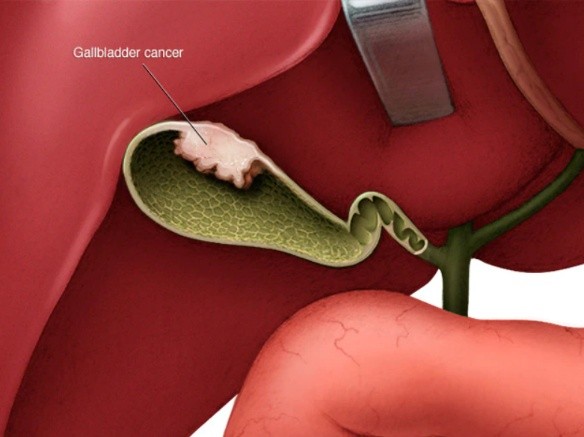
Gallbladder cancer is an abnormal growth of cells that begins in the inner layer (mucosal layer) of gallbladder. Gallbladder is a small, pear-shaped organ on the right side of abdomen, just beneath the liver. The gallbladder stores bile, a digestive fluid produced by your liver.
Gallbladder cancer is fairly common in India although a rare entity in western world. When it is detected at its earliest stages, the chance for a cure is excellent. Unfortunately, most gallbladder cancers are discovered at a later stage, when the prognosis is often poor. Gallbladder cancer may not be discovered until it is advanced, because it often causes no specific signs or symptoms.
Causes:
The exact cause of carcinoma of Gallbladder is not known. Gallbladder cancer forms when healthy gallbladder mucosal cells develop changes (mutations) in their DNA. These changes signal the cells to grow out of control and to continue living when other cells would normally die. The accumulating cells form a tumor that can grow beyond the gallbladder and spread to other parts of body. Most gallbladder cancer begins in the cells that line the inner surface (mucosa) of gallbladder. Gallbladder cancer that begins in this type of cell is called adenocarcinoma which can be diagnosed under microscope. Other rare types are squamous cell carcinoma, melanoma, small cell carcinoma etc.
Risk factors:
Factors that can increase the risk of gallbladder cancer include:
- It is more common in women.
- Age. Your risk of gallbladder cancer increases as you age. Most commonly seen after 60 years of age.
- Gallstones. Gallbladder cancer is most common in people who have gallstones or have had gallstones in the past.
- Other gallbladder diseases and conditions. Few conditions that can increase the risk of gallbladder cancer include polyps, chronic inflammation and infection.
- Inflammation of the bile ducts. Primary sclerosing cholangitis, which causes inflammation of the ducts that drain bile from the gallbladder and liver, increases the risk of gallbladder cancer.
Symptoms:
At early stage often it is asymptomatic. Sometime it is discovered in histopathological examination of specimen after cholecystectomy.
Gallbladder cancer signs and symptoms may include:
- Abdominal pain, particularly in the upper right portion of the abdomen.
- Abdominal bloating and indigestion.
- Weight loss and decreased appetite.
- Yellowing of the skin and whites of the eyes (jaundice)
- Vomiting
- Abdominal distension with fluid accumulation (Ascites).
- On and off Fever.
Diagnosis:
Blood Test: No blood test can detect Gall Bladder cancer specifically. CA19.9 and CEA levels in blood can help your doctor to monitor after cancer treatment.
Ultrasonography: It can show the growth in the gall bladder wall, wall thickness or some lesions in liver.
CECT and MRCP: Most people with gallbladder cancer will undergo a series of scans to help determine whether the cancer has spread or remains localized. Imaging tests that can create pictures of the gallbladder including computerized tomography (CT) and magnetic resonance imaging (MRI) can diagnose gall bladder cancer. It can show gall bladder mass, irregular thickness of gall bladder wall, regional lymph nodal enlargement, presence of multiple liver nodules (metastasis) or presence of fluid in the abdominal cavity.
PET CT SCAN: This is done to rule out any distant metastasis.
Staging:
Your doctor uses information from these procedures to assign your cancer a stage. The stages of gallbladder cancer range from 0 to IV. The earliest stages indicate a cancer that’s confined to the gallbladder mucosa and these are fairly curable. Later stages indicate more-advanced cancer that has grown to involve nearby organs or has spread to other areas of the body. Stage IV disease are incurable.
Treatment:
Treatment of gallbladder cancer depends on the disease condition, stage of the disease and overall health and fitness.
The initial goal of treatment is to remove the gallbladder cancer, but many a times that isn’t possible due to the advanced nature of the disease, other therapies may help control the spread of the disease and keep you symptomatically as comfortable as possible.
Surgery for early-stage gallbladder cancer:
Surgery is an option for early-stage gallbladder cancer.
- Cholecystectomy. Very early gallbladder cancer that is confined to the gallbladder mucosa is treated with removal of the gallbladder (cholecystectomy) only. In these scenarios often the patient diagnosed with cancer after cholecystectomy only.
- Radical Cholecystectomy (Surgery to remove the gallbladder and a portion of the liver and regional lymph nodes). Gallbladder cancer that extends beyond the gallbladder mucosa and sometimes into the liver is treated with surgery to remove the gallbladder, as well as a portions of the liver and regional draining lymph nodes. This is the only curable option in carcinoma of gall bladder.
- Completion Radical Cholecystectomy: Many a times patient came to know about their disease only after laparoscopic cholecystectomy. In these cases, re-surgery to remove part of liver around the gall bladder fossa and regional lymph nodes is indicated.
If your gallbladder cancer is very small and can be removed completely with Radical cholecystectomy, you may not need additional treatments. If there’s a risk that cancer is advanced one and, your doctor may recommend chemotherapy or other systemic treatments.
Now a days minimally invasive surgery for carcinoma gall bladder in the form of Robotic Radical Cholecystectomy is also available in many oncology centers.
Chemotherapy:
Chemotherapy uses drugs to kill rapidly growing cancer cells. Chemotherapy can be administered through a vein or in a pill form or both.
Chemotherapy might be recommended after surgery in advanced gallbladder cancers. Many a times chemotherapy is used before surgery to downstage the disease. It is also used to control the cancer if surgery isn’t an option in cases of spread-out disease.
Radiation therapy:
Radiation therapy uses high-powered beams of energy, such as X-rays to kill cancer cells. The energy beams come from a machine that moves around you as you lie on a table. Radiation therapy is sometimes combined with chemotherapy after surgery for gallbladder cancer if the cancer couldn’t be removed completely. Radiation therapy can also control gallbladder cancer that’s causing pain if surgery isn’t an option.
Targeted drug therapy:
Targeted drug treatments focus on specific molecular targets present within cancer cells. By blocking these, targeted drug treatments can cause cancer cells to die. Targeted drugs might be an option for people with advanced gallbladder cancer. Your doctor may test your cancer cells in tumor specimen to see which targeted drugs are most likely to work for you.
Immunotherapy:
Immunotherapy is a drug treatment that helps your immune system to fight cancer. Your body’s disease-fighting immune system might not attack cancer because the cancer cells produce proteins that make it hard for the immune system cells to recognize the cancer cells as dangerous. Immunotherapy works by interfering with that process. Immunotherapy might be an option for treating advanced gallbladder cancer.