
Breast Cancer:
Breast cancer is one of the most common malignancies in women and a leading cause of cancer related death. It happens when cancerous cells in the breast tissue multiply rapidly and forms a tumor. About 80% of breast cancer cells are invasive, means it can spread to the other part of the body.
Breast cancer typically affects women aged 50 years or more, though it can occur in younger women also. Although rare but men can also develop breast cancer.
Breast Cancer Types:
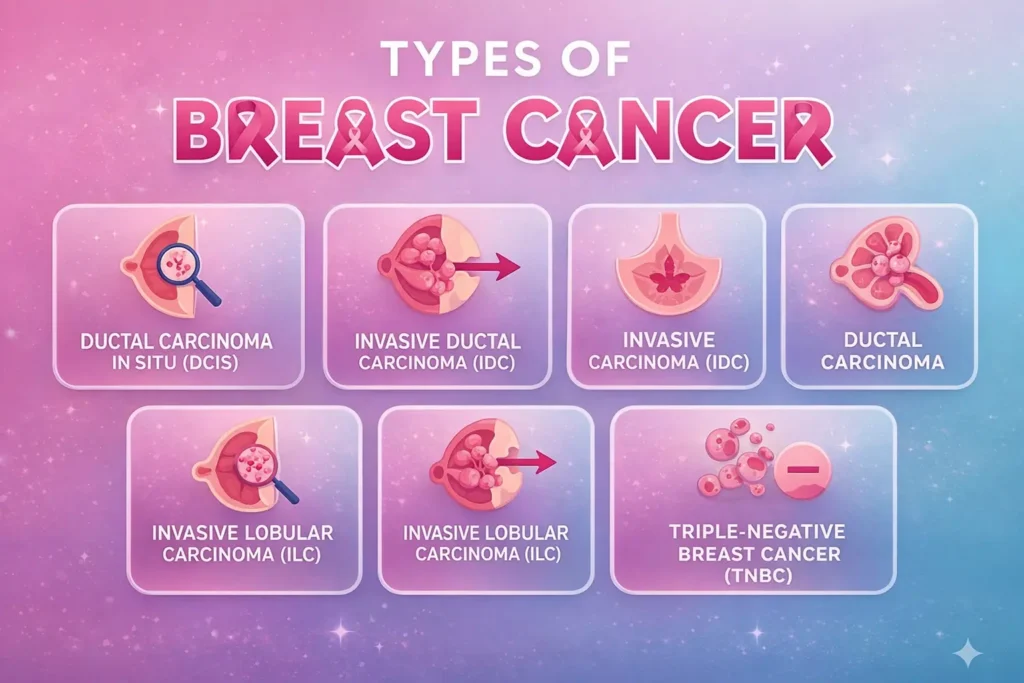
Breast cancers can be roughly divided into following common types:
1. Infiltrating Ductal Cancer (IDC).
2. Infiltrating Lobular Carcinoma.
3. Ductal Carcinoma in situ (DCIS).
4. Inflammatory Breast Cancer.
5. Paget’s Disease of the Breast.
Causes of Breast Cancer:
Most of the times the exact cause is unknown. Few factors which can predispose to cancer are as follows:
1. Age- Older age group.
2. Sex- 99% of breast cancer occur in females and men constitute only 1% of total breast cancer cases.
3. Family History: persons having family history of various cancers are more prone to develop breast cancer. If your mother, father, siblings, uncle, aunt are suffering from cancers, then you are having more chance to develop breast cancer.
4. Genetic Factors: About 10% can have genetic predisposition due to mutation of various genes eg. BRCA1 and BRCA2 genes.
5. Endogenous Estrogen: Early menarche and late menopause, nulliparity, older age first child birth.
6. Smoking: Tobacco smoking is linked to various cancers including Breast cancer.
7. Obesity.
8. Alcohol: Heavy alcohol intake is shown to be associated with development of breast cancer.
9. Hormone Replacement Therapy.
10. Prior Radiation to Head and Neck and Chest area.
Clinical Features:
1. Breast Lump is the most common symptom of breast cancer.
2. Bleeding from Nipple or Nipple discharge.
3. A change in size, shape or contour of breast.
4. Hardness of skin of the breast, redness over the skin.
5. Nipple inversion.
Diagnosis and Tests:
1. Ultrasonography and Sono-mammography of both breasts.
2. X-ray mammography of both breasts.
3. Breast Biopsy (Tru Cut Biopsy)
4. PET CT when required.
5. Sometimes MRI of Breasts.
Treatment Planning:
With breast cancer being leading cancer as well as leading cause of mortality among women, chances are there that you or someone you know and love can be diagnosed with this ailment. Choosing the right cancer centre with advanced technologies and eminent faculties, from starting of your treatment can make a big difference in outcome.
Multidisciplinary tumor board discussion by a team of surgical oncologist, medical oncologist, radiation oncologist, pathologist and radiologist will review the individual case and decide personalized care for each case depending on the stage of the disease
Core treatment modalities for localized disease are—
1. Surgery.
2. Chemotherapy.
3. Hormonal Therapy.
4. Targeted therapy and Immunotherapy.
5. Radiation therapy.
6. Palliative and supportive care
Surgery: Surgery plays a key role and only option of cure in localized and locoregional disease.
Surgery can be as follows:
a) Mastectomy (MRM): It entails removal of the whole breast along with removal of the axillary lymph nodal area.
b) Breast Conservation Surgery (BCS): It involves removal of the tumor with adequate clear margin with preservation of the breast. During BCS surgery Frozen Section Biopsy is done to ascertain the margin status. It is technically demanding.
c) Axillary Dissection (ALND): In ALND lymph nodes in the same side of the armpit area are removed along with the surgery for the breast tumor.
d) Sentinel Lymph Node Biopsy (SLNB): Here special dye is used to map the first draining lymph node in the axillary area, remove it during the surgery and submitted for frozen section biopsy to see it is involved by tumor or not. This can sometime avoid ALND and its complications.
e) Reconstruction of Breast Tissue: Oncoplastic Surgery, Regional flap or Free flap reconstruction, Breast Implants.
Preventive measures:
Few of the preventive measures for breast cancers are as follows- Early pregnancy and Breast feeding, Regular exercise and weight management, avoid alcohol and smoking and regular screening as indicated.
Screening for Breast cancer: Screening is done in healthy persons who are more prone to develop breast cancers due to various factors. Screening tests include—
1. Regular clinical Breast Examination
2. Screening Mammography bilateral breasts.
We deal with all kind of Breast cancer surgeries, including Radical Resections, Breast Conservative surgeries, axillary dissections, Sentinel Lymph Node Biopsy Techniques as well as various oncoplastic reconstructive procedures. With breast cancer being leading cancer as well as leading cause of mortality among women, chances are there that you or someone you know and love can be diagnosed with this ailment. Choosing the right cancer centre with advanced technologies and eminent faculties, from starting of your treatment can make a big difference in outcome.
Programme highlights include:
Collaborative multi-team approach for each patient by nationally recognized experts working together in an integrated programme.
Superior diagnostic capabilities:
- Digital Mammography, Breast Ultrasound, 3T Breast MRI, Image-guided Breast Core Biopsy, PET / CT scan, Sophisticated Interventional Radiology Procedures (Wire
Localization) and Stereotactic Biopsy, Screening Mammography. - Sentinel Lymph Node Evaluation (SLNB) using advanced Gamma Probe.
Advanced treatment options.
- Breast Conservation Surgery and Oncoplastic techniques for Complex Primary Tumours.
- Single Dose Intra-operative Radiation Therapy (IORT) and 3D Conformal Partial Breast Irradiation (CPBI) which can minimize radiation treatment duration.
- Skin Sparing Mastectomy which salvages most of the normal skin of the breast with Breast Reconstruction procedures that go beyond Breast Implants or Conventional Tissue Flaps.
- Survivorship Programs for both the patients and family members.
- Genetic Counselling.